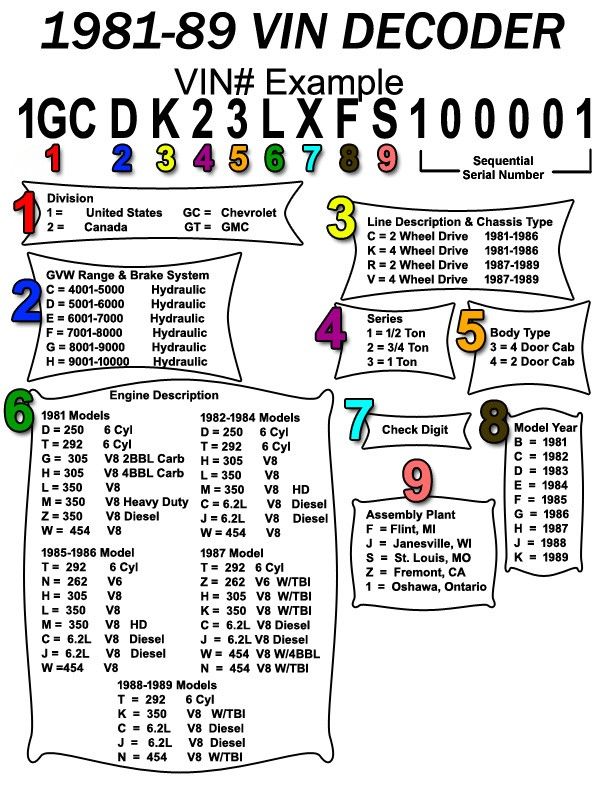
Chevrolet Gear Ratio Decoder: Instantly Decrypt Your VIN
Ever wondered if you could decipher your Chevy's gear ratio by simply looking at its Vehicle Identification Number (VIN)? While a VIN decoder can unlock a wealth of information about your vehicle, determining the gear ratio isn't one of them. The gear ratio of a vehicle is typically found in the owner's manual or can be calculated using specific vehicle data.
Before delving into how to find or calculate the gear ratio, let's understand what it is. In simple terms, a gear ratio is the relationship between the number of teeth on two interlocking gears. In the context of vehicles, it refers to the numerical relationship between your vehicle's engine speed and its road speed, essential for determining acceleration, fuel efficiency, and top speed.
Finding the Gear Ratio in Your Owner's Manual
If you're lucky, you might find the gear ratio listed in your vehicle's owner's manual. Chevrolet, like many manufacturers, provides this information for reference. However, this isn't always the case, and you might have to dig a bit deeper.


Here's a step-by-step guide on how to find your owner's manual's gear ratio information:
Understanding Gear Ratios
Gear ratios are usually expressed as a pair of numbers, such as 3.08:1 or 3.73:1. The first number represents the number of teeth on the input gear (usually the driveshaft), while the second number represents the number of teeth on the output gear (usually the wheels). In the examples above, the input gear has 3.08 or 3.73 teeth for every tooth on the output gear.


For instance, in a 3.08:1 gear ratio, for every 3.08 revolutions the input gear makes, the output gear revolves once. This means that for every 3.08 feet the input gear moves, the output gear moves one foot.
Deciphering Axle Code
Another way to find your Chevy's gear ratio is by deciphering the axle code, a series of letters and numbers found on theitar axle label or within the vehicle's maintenance records. The axle code usually follows this format: " verpflicht: prorate " or "x:y prorate ". Here, x represents the diameter of the axle shaft in inches, while y represents the gear ratio.
For example, if your axle code reads "7.25:3.73 prorate ", it indicates a 7.25-inch axle shaft with a 3.73:1 gear ratio. However, this method might require some sleuthing, as not all vehicles have easily accessible axle codes or maintenance records.


Calculating the Gear Ratio
If you can't find the gear ratio through the owner's manual or axle code, you might need to calculate it yourself. This process requires knowing your vehicle's RPM (revolutions per minute) at a certain speed and its final drive ratio.
Here's a simplified step-by-step guide on how to calculate your gear ratio:
Understanding Your Vehicle's Final Drive Ratio
The final drive ratio represents the relationship between the number of teeth on the ring gear (part of the differential) and the pinion gear (part of the driveshaft). It's usually expressed as a ratio, such as 3.73:1 or 4.10:1. You can find the final drive ratio in your vehicle's parts catalog, owner's manual, or by requesting it from Chevrolet.


Determining Your Vehicle's RPM
To calculate your gear ratio, you need to know your vehicle's engine speed in RPM at a specific road speed. You can obtain this information using a tachometer or by looking up your vehicle's characteristic engine speed at a specific gear and speed combination (usually fifth gear at 60-70 mph) in its performance curves.
Let's assume you've determined your vehicle's final drive ratio (let's say 3.73:1) and its engine RPM at 60 mph in fifth gear (let's say 2,750 RPM). To calculate the gear ratio, you would use the following formula:
Gear Ratio = (Engine RPM / Vehicle Speed) * Final Drive Ratio
In our example, it would look like this: Gear Ratio = (2,750 RPM / 60 mph) * 3.73:1 = 3.26:1
As you can see, this calculation gives you an approximate gear ratio. The final drive ratio refers to the differential, while the gear ratio generally encapsulates the entire drivetrain. Nonetheless, it provides a good, ballpark estimate of your vehicle's overall gear ratio.
In conclusion, while a VIN decoder can provide fascinating insights into your Chevy's heritage, it's unable to divulge the exact gear ratio. By understanding what gear ratios are, knowing where to look in your owner's manual or records, and even calculating it using specific vehicle data, you can successfully determine your vehicle's gear ratio. Happy motoring!
Related Articles

"1984 Chevy Blazer Gear Ratio: Find the Perfect Gearing for Your Classic SUV"
The 1984 Chevrolet Blazer, a iconic SUV from GM's lineup, is renowned for its versatility and durability. One critical aspect that significantly impacts its...

Frame Chevy Mineola NY: Your Local Chevrolet Expert
Nestled in the vibrant heart of New York, Mineola is home to a cherished icon of American automotive history - Frame Chevrolet. This reputable dealership isn't...

Ross Downing Chevy: Your Trusted Chevrolet Dealer
When you think of Chevy, you might think of iconic American muscle cars or reliable family vehicles. But did you know that there's a whole world of Chevy truck...

2500 Ram: Optimizing Your Gear Ratio
Ever wondered how your 2500 Ram's transmission ensures a smooth ride across various terrains? The secret lies in its gear ratios, which cleverly use the...

1992 Chevy 1500: Does Your Truck Die in Gear? Expert Troubleshooting Tips
Are you a proud owner of a classic 1992 Chevrolet 1500, also known as the C/K series, but facing a worrisome issue? It's frustrating when your reliable pickup...

Ford 9-inch Gear Ratios: Your Ultimate Drive Ratio Guide
Ford's transmission setup offers a range of gear ratios, with the 9-inch ratio being a popular choice among enthusiasts and professionals alike. This ratio...